From Payment to Internet Access Automatically: How PulseISP Automates Captive Portal Payments & Vouchers
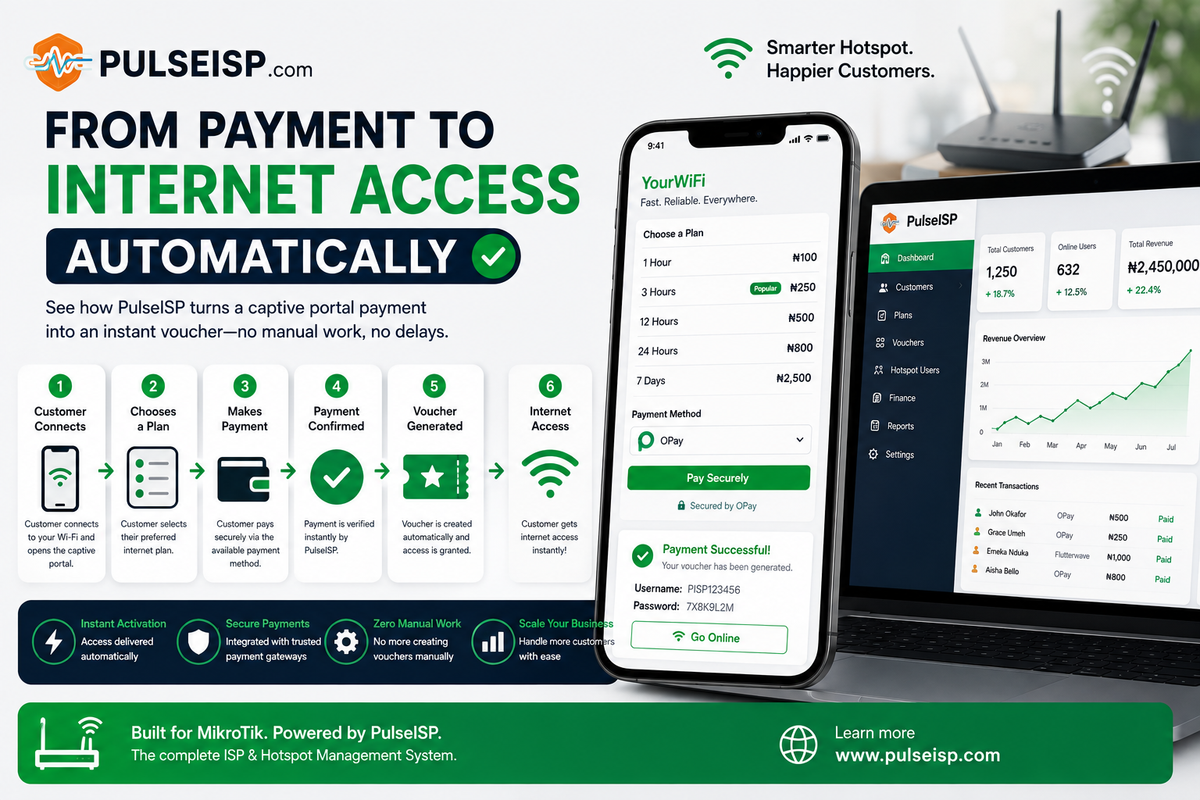
See how PulseISP turns a captive-portal payment into an instant internet voucher—without manually creating or sending credentials. In this walkthrough, you'll see the complete flow from customer payment to automatic voucher generation and internet access.
Running a hotspot business sounds simple.
Customers connect to your Wi-Fi, they choose a plan, they pay, and they get internet access.
But if you're managing those steps manually, the process can quickly become a full-time job.
A customer sends a transfer.
You check your bank account.
You confirm the payment.
You open MikroTik.
You create a voucher.
You send the voucher to the customer.
Then you repeat the process.
Do this for 10 customers and it might be manageable.
Do it for 100 or 500 customers, and you've built yourself a job.
This is exactly the kind of repetitive work PulseISP is designed to eliminate.
With PulseISP, your MikroTik captive portal can become a self-service payment and internet activation system where customers can choose a plan, make payment and receive their internet access without you manually creating a voucher for every transaction.
The Old Way of Running a Hotspot
Let's imagine you're running a hotspot at a hotel, estate, restaurant, event centre, student accommodation, rural community or Starlink-powered Wi-Fi business.
A customer connects to your network.
They see your captive portal.
They want three hours of internet.
You tell them:
"Send ₦500 to this account."
They make the payment.
Then they message you:
"I've paid."
You check your phone.
You confirm the payment.
You create a MikroTik voucher.
You send the voucher.
The customer enters the voucher.
Finally, they get online.
Nothing is technically wrong with this process.
The problem is that you're involved in every single transaction.
And that's where the business starts becoming difficult to scale.
What If the Customer Could Do Everything Themselves?
This is the idea behind PulseISP's captive portal payment flow.
Instead of:
Customer → Payment → You → Voucher → Customer
you can move towards:
Customer → Captive Portal → Choose Plan → Pay → Automatic Activation → Internet
The customer doesn't need to wait for you.
You don't need to manually confirm every transaction.
You don't need to manually generate every voucher.
And you don't need to be sitting beside the MikroTik router waiting for customers to pay.
That's the difference between selling internet manually and automating your internet business.
How PulseISP Handles the Process
The entire customer journey can be built around your captive portal.
Here's what it looks like.
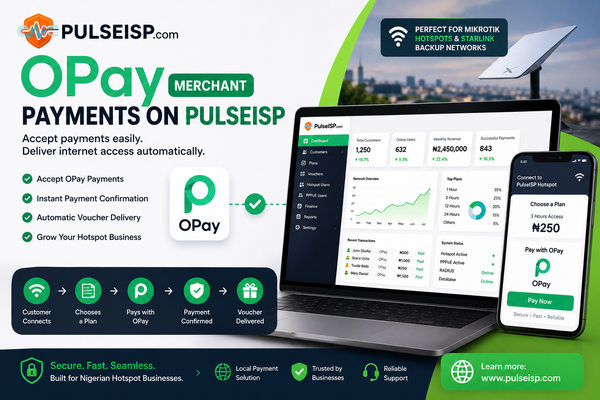
1. Customer Connects to Your Wi-Fi
The customer connects their phone, laptop or other device to your MikroTik-powered hotspot.
Instead of immediately getting unrestricted internet access, they're presented with your captive portal.
This is your digital storefront.
They can see the internet packages you have available.
For example:
| Plan | Price | Access |
|---|---|---|
| 1 Hour | ₦100 | 1 hour |
| 3 Hours | ₦250 | 3 hours |
| 12 Hours | ₦500 | 12 hours |
| 24 Hours | ₦800 | 24 hours |
| 7 Days | ₦2,500 | 7 days |
Your actual packages and pricing are completely up to you.
The important part is that customers can select what they want directly from the portal.
2. The Customer Chooses a Package
Instead of contacting you, the customer simply selects their preferred plan.
This is where your captive portal starts doing the job of a salesperson.
They can see:
- Package name
- Price
- Duration
- Available access
- Payment option
They select the package and proceed to payment.
No WhatsApp conversation is required.
No phone call is required.
No staff member needs to manually create an account.
3. The Customer Pays
The customer completes payment through the payment method you've configured on your PulseISP installation.
This is particularly useful for Nigerian hotspot operators because customers can pay using familiar local payment methods rather than having to rely on complicated manual transfers.
The payment is processed through the configured gateway.
Once the transaction is successfully confirmed, the important part begins.
4. PulseISP Confirms the Payment
This is where automation changes the experience.
Instead of you watching your bank account or payment dashboard and manually deciding whether the customer should receive internet access, the payment confirmation can trigger the next step in the process.
Payment confirmed.
The system knows which customer made the payment.
It knows which package they purchased.
It knows how long that package should remain active.
And it can proceed with provisioning the customer's access.
5. The Voucher Is Generated Automatically
This is one of the most useful parts of the workflow for hotspot operators.
Once payment is successfully completed, PulseISP can generate the corresponding voucher/access credentials automatically.
You don't have to open Winbox.
You don't have to create a username manually.
You don't have to type a random password.
You don't have to search through a list of available vouchers.
The system handles the provisioning process based on the package the customer purchased.
The customer gets the access details and can proceed to connect.
Payment → Voucher → Internet.
Automatically.
6. The Customer Gets Online
The final step is what the customer actually cares about.
They paid.
They want internet.
They shouldn't have to wait for the business owner to wake up, check WhatsApp, confirm a bank transfer and create a voucher.
With an automated captive portal workflow, the customer's experience becomes much closer to buying a product from an online store.
Choose.
Pay.
Access.
That's how a hotspot should feel.
You Don't Have to Be the Voucher Generator
This sounds like a small thing until you actually operate a busy hotspot.
Imagine 50 customers purchasing access throughout the day.
If every transaction requires you to:
- Confirm the payment
- Create a voucher
- Assign the right profile
- Send the credentials
- Help the customer connect
you've created dozens of administrative tasks.
Now imagine 500 customers.
The problem isn't that MikroTik can't handle the network.
The problem is you've made yourself part of the network's payment infrastructure.
PulseISP removes you from that loop.
Your Captive Portal Becomes Your Sales Channel
A captive portal shouldn't only be a login page.
It can become the place where customers actually purchase their internet access.
Instead of displaying:
Username
Password
Login
you can create a much more useful customer journey.
Connect → Browse Plans → Select Plan → Pay → Get Access
That means your captive portal is effectively doing the work of:
- A storefront
- A payment page
- A plan selector
- A customer activation system
- A voucher delivery system
all within your hotspot experience.
This Works Especially Well for Unattended Hotspots
One of the biggest advantages of this model is that your business doesn't have to be constantly staffed.
Think about locations such as:
Hotels
Guests can purchase internet access without calling reception.
Restaurants & Cafés
Customers can purchase Wi-Fi while they're there.
Events
Visitors can purchase temporary internet access without needing an operator to manually issue vouchers.
Estates
Residents can purchase or renew internet packages through the network.
Student Accommodation
Students can buy hourly, daily, weekly or monthly access.
Rural & Community Wi-Fi
Customers can purchase access even when there isn't an employee sitting beside the network.
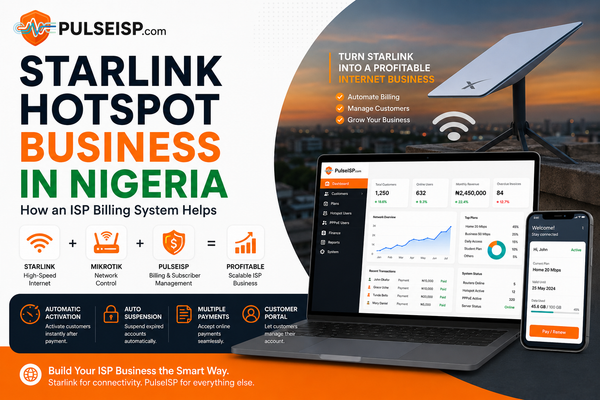
Starlink Hotspots
If you're using Starlink as your upstream connection and MikroTik to distribute the connection, PulseISP can provide the customer management and billing layer around that network.
The physical location can change.
The business model remains the same.
What Happens When You Have Multiple Plans?
This is another area where automation becomes important.
Suppose your hotspot has:
- 1-hour access
- 3-hour access
- 12-hour access
- 24-hour access
- 7-day access
- 30-day access
A customer shouldn't need to tell you:
"I want the 24-hour voucher."
They simply select the 24-hour package.
The system already knows the rules associated with that plan.
That means the package the customer purchases determines the access they receive.
Your business becomes product-driven instead of operator-driven.
What Happens When the Voucher Expires?
This is another task that becomes painful when handled manually.
Imagine you have 300 active vouchers.
Some expire today.
Some tomorrow.
Some next week.
Some were purchased for one hour.
Others are valid for a month.
You don't want to maintain a spreadsheet telling you which customer should be disconnected at what time.
The access period is tied to the service purchased.
When that access period ends, the customer's access can expire according to the rules configured for the service.
Again, the goal is simple:
The system should enforce the rules so you don't have to.
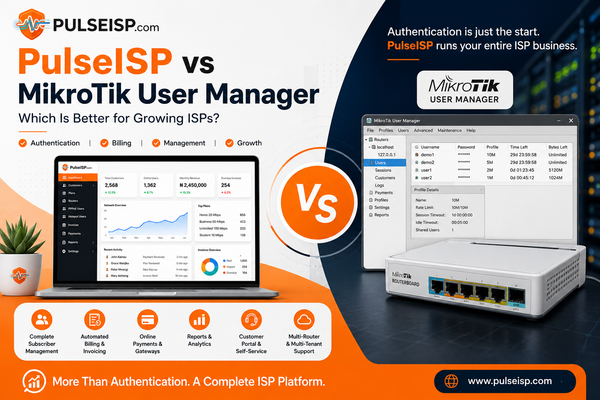
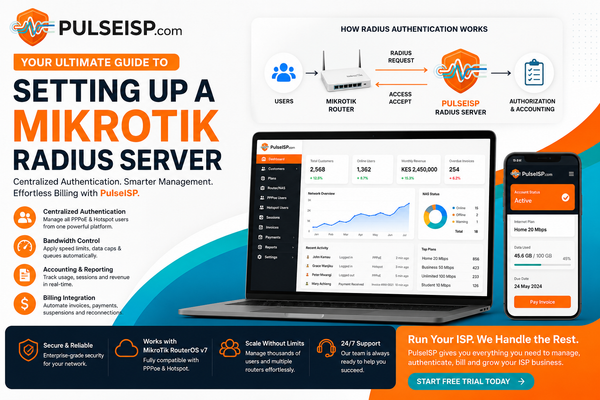
Your MikroTik Handles the Network. PulseISP Handles the Business.
It's important to understand the division of responsibilities.
Your MikroTik is still doing what MikroTik does best.
It controls the network.
It handles the hotspot.
It controls authentication and access.
It enforces network policies.
PulseISP sits above that infrastructure and provides the business management layer.
It can handle things such as:
- Customers
- Internet plans
- Payments
- Vouchers
- Subscriptions
- Access management
- Billing
- Usage and network-related information
So instead of trying to turn MikroTik into your entire business management system, you give it a platform that works alongside it.
You Don't Need to Manually Check Every Payment
This is perhaps the biggest operational advantage.
Imagine you're running a hotspot while you're away from the location.
A customer connects at 11:30 PM.
They purchase a package.
They make payment.
The payment is confirmed.
Their access is provisioned.
They get online.
You didn't have to touch anything.
That's what automation should do.
It should allow your business to continue operating even when you're not physically sitting in front of it.
From "Please Send Me a Voucher" to Self-Service Internet
There's a major difference between these two experiences.
Manual Hotspot
Customer:
"How much is Wi-Fi?"
You:
"₦500."
Customer:
"Where do I pay?"
You send account details.
Customer pays.
Customer:
"I've paid."
You check.
You create a voucher.
You send it.
Customer:
"It isn't working."
You troubleshoot.
Repeat.
Automated Hotspot
Customer connects.
They see your plans.
They choose a plan.
They pay.
Payment is confirmed.
Access is generated.
They connect.
Done.
That's the experience PulseISP is built to help you create.
And You Can Watch the Whole Process
I've also put together a video showing this workflow in action.
In the video, you can see how a customer goes through the captive portal, selects an internet package, completes the payment and gets their access generated automatically.
It's worth watching if you're planning to build a MikroTik hotspot or you're currently issuing vouchers manually.
You can see exactly what the customer experience looks like and how the payment-to-access process works.
Why This Matters for Your Hotspot Business
Automation isn't just about saving a few clicks.
It changes the way you can operate your business.
When payments, provisioning and access management are connected, you can operate with fewer manual processes.
That means you can spend more time on:
- Finding new customers
- Expanding your coverage
- Improving your network
- Creating better packages
- Marketing your service
- Supporting customers when they actually need help
Instead of spending your day creating vouchers.
Your Goal Shouldn't Be to Manage More Customers
Your goal should be to manage more customers without creating more work for yourself.
That's the real advantage of automation.
If doubling your customers means doubling your administrative work, your business has a problem.
But if your system can handle much of the repetitive work automatically, growth becomes much easier.
That's where PulseISP fits.
Build a Hotspot That Can Sell While You're Away
Your customers shouldn't have to wait for you to be online before they can buy internet access.
Your staff shouldn't have to manually generate every voucher.
You shouldn't have to check every payment before activating a customer.
Your MikroTik network shouldn't depend on someone sitting beside it all day.
Connect the network. Configure your plans. Connect your payment gateway. Let the system handle the repetitive work.
That's the idea behind PulseISP.
Customer connects → chooses a plan → pays → payment is confirmed → access is generated → customer gets online.
No manual voucher creation.
No unnecessary WhatsApp conversations.
No waiting for an administrator.
Just a smoother way to sell internet access.
Ready to Automate Your Hotspot?
If you're running a MikroTik hotspot, Starlink-powered Wi-Fi business, hotel network, estate network, community Wi-Fi or any other paid internet service, PulseISP gives you the tools to move beyond manually managing every customer.
Run your network. Automate your billing. Let your customers buy their own access.