Starlink Hotspot Business in Nigeria: How an ISP Billing System Makes It Easier
Learn how to build a Starlink-powered hotspot business in Nigeria and how PulseISP can automate customer billing, payments, subscriptions, bandwidth management and service expiry as your network grows.
Starlink has changed the conversation around internet connectivity in Nigeria.
For businesses, hotels, estates, event centres, restaurants, campuses, rural communities and entrepreneurs in locations where traditional fibre or wireless backhaul is difficult to obtain, Starlink can provide a practical way to get high-speed internet where it was previously unavailable.
But there is an important distinction between having Starlink and running a Starlink-powered internet business.
Getting the internet connection is only the beginning.
Once you start charging customers for access, you need a way to create packages, authenticate users, collect payments, activate customers, suspend expired accounts, manage bandwidth and keep track of what is happening across your network.
That is where an ISP billing system becomes extremely valuable.
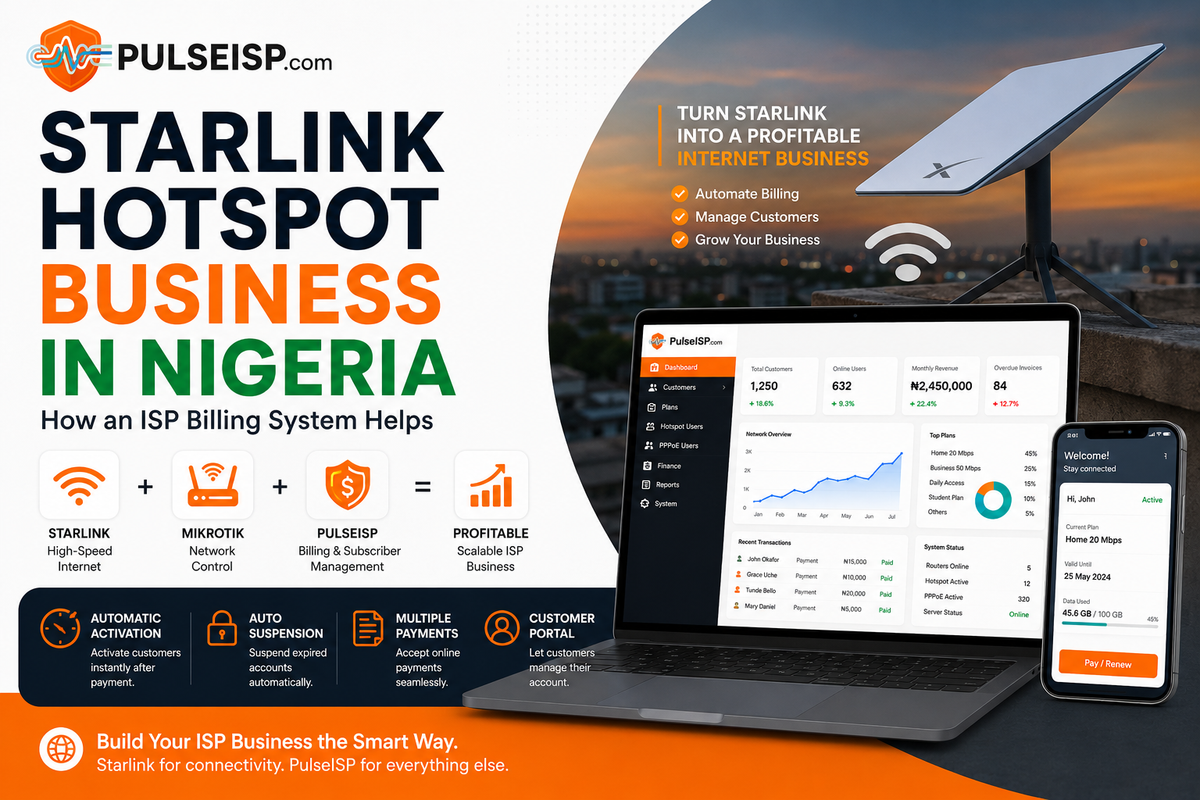
With a platform such as PulseISP, Starlink can serve as the upstream internet connection while your MikroTik network and billing platform handle the customer-facing side of the business.
What Is a Starlink Hotspot Business?
A Starlink hotspot business is essentially a managed Wi-Fi or internet access service where Starlink provides the upstream connectivity and customers pay you for access to your network.
The setup can be as simple as:
Starlink → MikroTik Router → Access Points → Customers
But the moment you have paying customers, the operation becomes more complicated.
You may have:
- Customers buying different internet packages
- Hourly, daily, weekly or monthly plans
- Different bandwidth limits
- Prepaid vouchers
- PPPoE subscribers
- Hotspot users
- Customers whose subscriptions expire at different times
- Multiple access points
- Multiple MikroTik routers
- Payment confirmations
- Customer notifications
- Expired accounts that need to be disconnected
You don't want to manage all of that manually.
That is where billing software comes in.
Starlink Provides the Internet. It Doesn't Run Your ISP Business.
This is probably the most important thing to understand.
Starlink is your connectivity provider.
It gives your network internet access.
It does not become your customer management system simply because you are using Starlink.
If you want to operate a hotspot or community Wi-Fi business, you still need a system for managing the people who connect to your network.
Think about the roles separately.
| Layer | What it does |
|---|---|
| Starlink | Provides internet connectivity |
| MikroTik | Controls network access and traffic |
| Access Points | Provide Wi-Fi coverage |
| ISP Billing System | Manages customers, plans, payments and access |
This separation is what allows a Starlink connection to become part of a properly managed internet business.
Can You Actually Use Starlink for a Hotspot Business?
This is where you need to pay attention to the service plan you purchase.
Starlink's terms currently prohibit unauthorized resale of its services, but specifically provide an exception for customers on eligible Priority Plans who may resell access as community Wi-Fi or a hotspot to third parties.
That means you shouldn't simply assume that any Starlink subscription can be connected to a MikroTik and resold.
Before launching a commercial hotspot, check the current Starlink terms and the specific service plan available for your location.
Starlink currently advertises business service in Nigeria, with its Business 2TB plan listed at ₦226,000/month at the time of writing.
You should also consider the Nigerian regulatory requirements applicable to your planned internet service. The Nigerian Communications Commission publishes guidelines covering licensed internet service providers, and its licensing materials list Internet Services (ISP) as a licensed service.
The goal isn't simply to get Starlink working.
The goal is to build the business correctly.
Where Things Get Difficult
Imagine you start a small hotspot around an estate, hotel, student accommodation, rural community or business center.
At first, you might have 10 customers.
You could probably manage everything manually.
Someone pays you.
You create an account.
You send them the credentials.
They connect.
At the end of the month, you check who has paid.
Then you manually disconnect whoever hasn't.
It works.
Until you have 50 customers.
Then 100.
Then 300.
Suddenly, your "simple hotspot" is becoming an ISP operation.
And you're spending your time doing administration instead of growing the business.
What Happens Without Billing Software?
Without an ISP billing platform, you can end up with spreadsheets, WhatsApp messages, screenshots of transfers, manual voucher creation and customers constantly asking:
"Has my payment reflected?"
"Why am I still disconnected?"
"Please extend my account."
"What's my username again?"
"I paid yesterday."
"Can you reconnect me?"
None of these tasks generate revenue.
They're operational overhead.
And as your customer base grows, that overhead grows with it.
This Is Where PulseISP Comes In
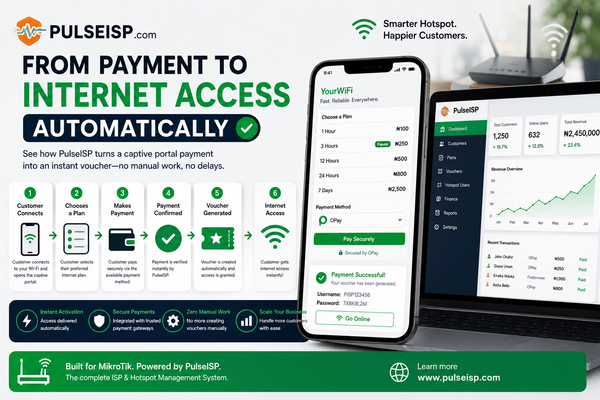
PulseISP Mikrotik Billing System is designed to sit between your network infrastructure and your business operations.
Instead of manually managing every subscriber on your MikroTik router, you manage customers and services from one central platform.
The basic idea becomes:
Starlink → MikroTik → PulseISP → Customers
Starlink provides the connectivity.
MikroTik controls the network.
PulseISP handles the business logic.
That means you can focus on selling internet instead of constantly administering it.
Turn Your Starlink Connection Into Managed Internet Packages
Suppose your Starlink-powered network serves an estate.
You could create packages such as:
Daily Access
24-hour internet access for casual users.
Weekly Access
Seven days of connectivity for temporary customers.
Monthly Home Plan
A recurring package for residents.
Business Plan
Higher bandwidth or priority service for businesses operating within the coverage area.
The important part isn't the names of the plans.
It's that the system can associate each customer with a specific service and automatically apply the rules associated with that service.
Instead of manually changing MikroTik settings every time somebody buys a different package, your billing platform becomes the control layer.
Automatic Customer Activation
This is one of the biggest advantages of using an ISP billing system.
Imagine a customer visits your hotspot.
They choose a package.
They make payment.
Instead of you receiving a WhatsApp message saying:
"I have paid. Please activate me."
the payment and provisioning process can be connected to your customer management workflow.
The customer's account can be created or updated, their service can be activated, and the appropriate network profile can be applied.
That's the difference between selling internet and manually administering internet accounts.
Automatic Expiry and Suspension
This becomes even more important as your customer base grows.
Let's say you have 250 customers.
Every customer has a different renewal date.
Some paid on the 1st.
Others paid on the 5th.
Others on the 12th.
Others on the 20th.
Without automation, you have to keep track of all of them.
With an ISP billing system, the customer's subscription status becomes part of the system.
When a service expires, the customer shouldn't continue receiving the service simply because you forgot to disconnect them.
The system can handle the service state while you concentrate on getting more customers.
That is one of the biggest reasons billing automation matters.
You Can Sell More Than One Type of Access
A Starlink-powered network doesn't have to be a simple "₦X per month" service.
You can build different products around the same infrastructure.
For example:
Pay-As-You-Go Wi-Fi
Customers purchase short-term access.
Useful for:
- Restaurants
- Hotels
- Events
- Waiting areas
- Transport terminals
- Public spaces
Monthly Internet
Customers pay a recurring fee for continued access.
Useful for:
- Estates
- Apartment buildings
- Student accommodation
- Rural communities
- Small business clusters
Voucher-Based Internet
Generate prepaid access codes that customers can purchase and redeem.
This can be particularly useful where customers prefer paying for a specific amount of access rather than maintaining a monthly subscription.
PPPoE Internet
For a more traditional ISP-style deployment, customers can connect through PPPoE and receive a specific service profile.
This gives you much more control over subscribers and bandwidth policies.
What About Bandwidth?
Starlink gives you the upstream connection.
But you still need to decide how that connection is shared among your customers.
You don't want one customer downloading a huge file while everyone else struggles to browse.
This is where MikroTik becomes extremely useful.
You can create different bandwidth profiles.
For example:
| Plan | Download | Upload | Duration |
|---|---|---|---|
| Basic | 5 Mbps | 2 Mbps | 30 days |
| Standard | 10 Mbps | 5 Mbps | 30 days |
| Premium | 20 Mbps | 10 Mbps | 30 days |
| Daily | 5 Mbps | 2 Mbps | 24 hours |
Your actual speeds should be designed around your available capacity, network conditions and customer demand.
The important thing is that your customers don't all need to receive the entire capacity of your Starlink connection.
You are building a managed network.
Starlink + MikroTik + PulseISP
This is where the architecture starts becoming interesting.
Starlink doesn't have to be your entire network.
It can simply be the backhaul.
Your MikroTik router becomes the network control point.
PulseISP becomes the management and billing layer.
A simplified architecture looks like this:
Starlink
↓
MikroTik Router
↓
PPPoE / Hotspot
↓
Access Points / CPEs
↓
Customers
And alongside the MikroTik:
PulseISP
↓
Customers + Plans + Payments + Billing + Network Management
This gives you separation between connectivity and business management.
And that means you're not locked into Starlink as your only possible upstream forever.
If fibre eventually becomes available in your area, for example, you can potentially introduce another connection and evolve your network.
The billing and subscriber management layer can remain the same.
What Does PulseISP Actually Save You From?
This is the part many new internet entrepreneurs underestimate.
The biggest cost of running a small ISP isn't always bandwidth.
It can be administration.
Imagine having 300 customers.
If every customer requires five minutes of manual work every time they renew, change plans or have an issue, the numbers add up quickly.
You start spending hours:
- Creating users
- Checking payments
- Activating accounts
- Disconnecting expired customers
- Changing bandwidth
- Searching for usernames
- Answering payment questions
- Checking who is online
- Updating spreadsheets
- Troubleshooting customer access
PulseISP is designed to reduce that operational workload.
Instead of building your business around manual administration, you build it around automation.
Your Customers Shouldn't Need to Know How Your Network Works
This is another important distinction.
Your customers don't care whether the internet reaches them through Starlink, fibre, wireless backhaul or another upstream provider.
They care about:
Can I connect?
How much does it cost?
How fast is it?
When does my subscription expire?
Can I pay easily?
Will I get disconnected when my plan expires?
That's what your business should be designed around.
The complexity should stay behind the scenes.
Start Small. Build the System Properly.
You don't need to launch with hundreds of customers.
A Starlink-powered hotspot could start with a relatively small coverage area.
You might begin with:
- One Starlink connection
- One MikroTik router
- A few access points
- A handful of service packages
- A payment method
- PulseISP for customer and billing management
Then grow from there.
As demand increases, you can expand your wireless coverage, add additional network equipment, introduce more service plans and potentially add additional upstream connections.
The important thing is that your operational system doesn't have to be rebuilt every time the network grows.
Is a Starlink Hotspot Business Profitable?
It can be, but the answer depends heavily on your location, Starlink plan, equipment costs, electricity, installation, coverage, customer density, pricing and how much usable capacity your customers actually consume.
Don't make the mistake of taking the Starlink monthly fee and simply dividing it by your planned customer count.
You have other costs.
Consider:
- Starlink hardware and service
- MikroTik equipment
- Access points
- Outdoor CPEs
- Mounting and installation
- Power
- Backup power
- Networking equipment
- Maintenance
- Internet capacity
- Staff or technical support
- Payment processing fees
- Regulatory and licensing obligations
- Customer acquisition
- Replacement equipment
Then calculate how many paying customers you need to cover your operating costs and generate a reasonable margin.
An ISP billing system doesn't magically make the business profitable.
What it does is make it easier to operate the business efficiently.
And efficiency matters when your margins are being squeezed by infrastructure costs.
Don't Build a Business Around a Spreadsheet
Spreadsheets are useful when you're planning the business.
They become much less useful when the spreadsheet becomes the system running the business.
If you're collecting payments from customers, managing subscriptions, controlling access and operating a real network, your billing and subscriber management should eventually move into a system designed for that job.
That's the difference between:
"I sell Wi-Fi."
and
"I operate an internet service."
Starlink Can Be the Starting Point — Not the Whole Business
One of the most interesting things about Starlink for Nigerian entrepreneurs is that it can reduce one of the biggest barriers to starting a network: obtaining usable upstream connectivity in places where traditional providers aren't practical.
But connectivity alone isn't the business.
The business is everything you build around that connection.
Your customers.
Your packages.
Your payments.
Your network.
Your support.
Your billing.
Your automation.
Your ability to scale.
That's where an ISP management platform becomes important.
Build the Network. Let PulseISP Handle the Busywork.
If you're considering launching a Starlink-powered hotspot, community Wi-Fi service, estate internet network or small ISP in Nigeria, don't think only about how you're going to get internet to the location.
Think about what happens after the first customer connects.
How will you sell the service?
How will you activate them?
How will you manage their subscription?
How will you enforce their plan?
How will you handle expiry?
How will you know what's happening across your network?
And what happens when you have 10 customers, then 100, then 500?
That's exactly the problem an ISP billing platform is meant to solve.
Starlink can provide the connection. MikroTik can control the network. PulseISP can help you run the business around it.
If you're building an ISP, hotspot or community Wi-Fi network and want to spend less time manually managing subscribers and more time growing the business, explore what PulseISP can do for your network.
Run your network. Automate your billing. Grow your ISP.